Project 02
SWARM
Autonomous multi-agent underwater system
- Project
- SWARM
- Role
- Controls & Hardware Engineer
- Organisation
- ARIS / ETH Zürich
- Period
- 2024–2025 · 1+ year
- Dwg no.
- CVW-02
- Rev
- B
1Problem
Underwater robots are usually tethered, expensive, and operate on their own. SWARM set out to build highly manoeuvrable, cost-efficient underwater drones as a scalable foundation for a multi-agent swarm: untethered agents that localise themselves, talk to each other and coordinate as a group in lake environments.
Multiple agents can cover a larger area faster and share the work between them — the long-term use cases range from inspecting offshore infrastructure to cleaning ship hulls and supporting search and rescue in the water.
2My role
Controls & Hardware Engineer for more than a year of the ETH Zürich focus project with ARIS, and Head of Sponsorships.
I owned the controls: the position and attitude controllers and the waypoint planner, which I designed, tuned and iteratively improved through testing in the water.
3System overview
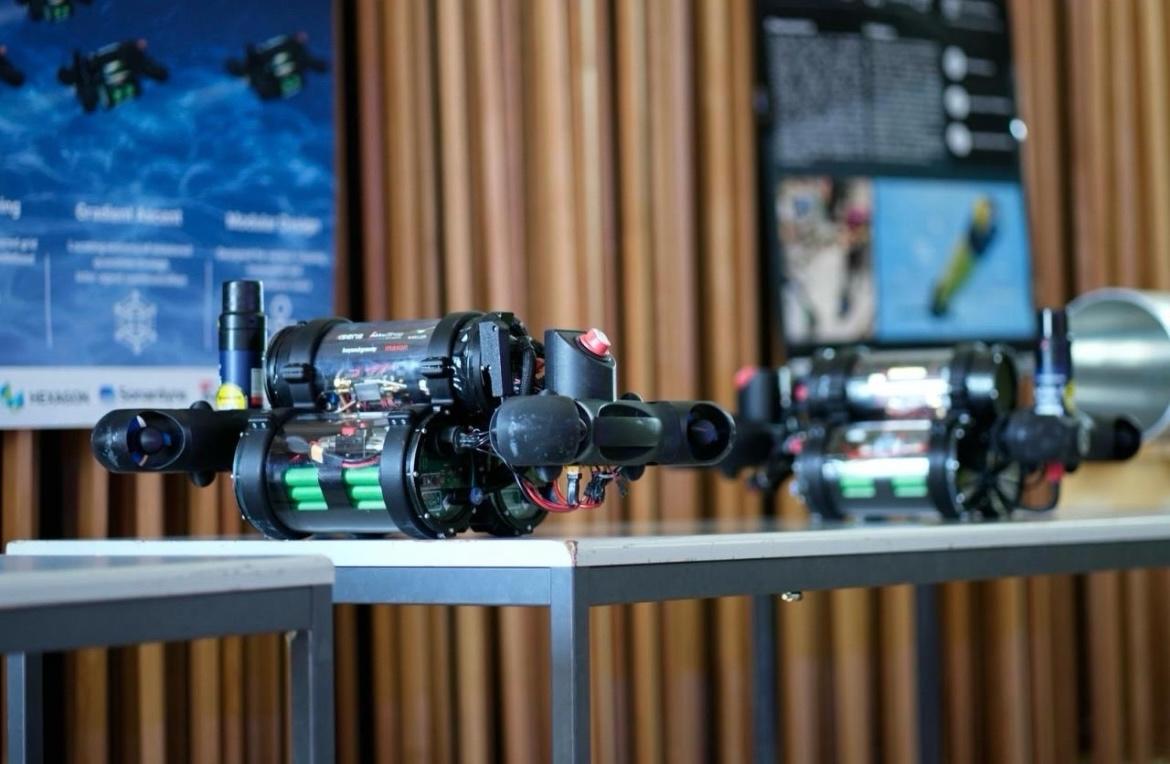
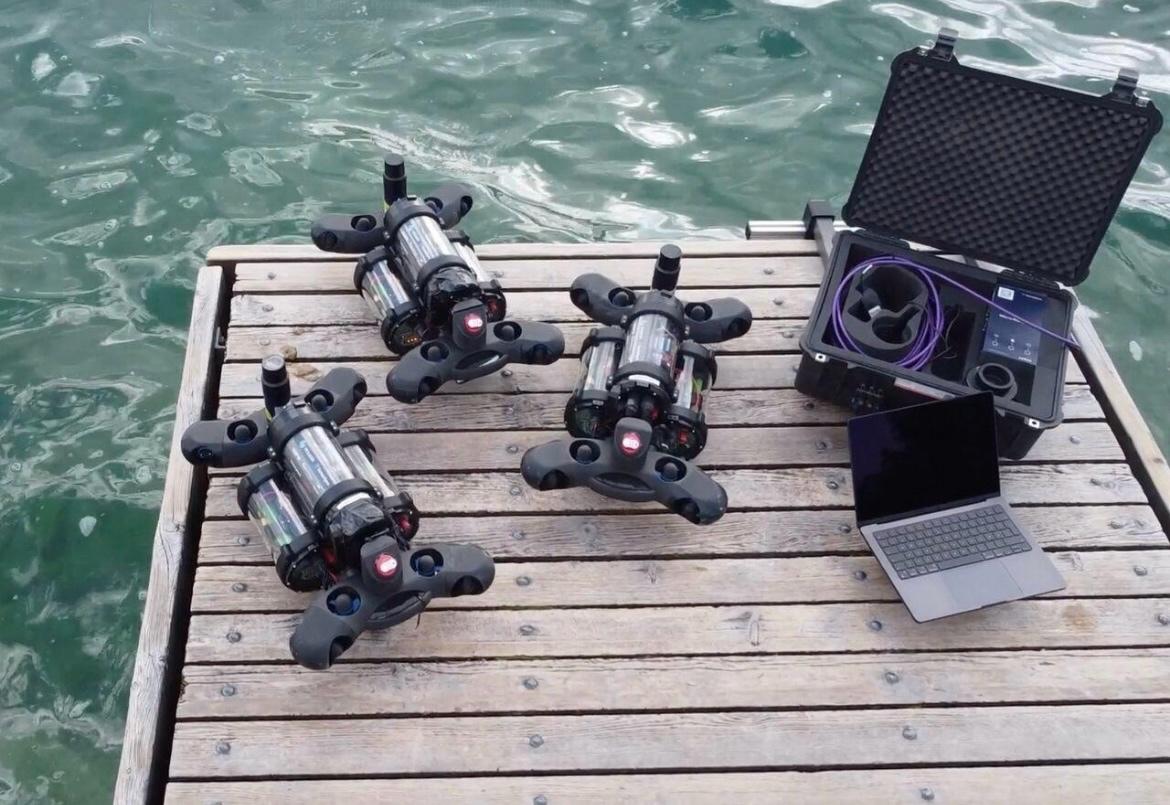
Three identical agents. Each one is built around an aluminium profile chassis carrying an electronics tube, battery tubes and two 3D-printed thruster arrays with eight thrusters in total, giving independent control of all six degrees of freedom.
A Raspberry Pi 5 handles all onboard computation and decisions. Navigation fuses an AHRS (Xsens IMU) with pressure-based depth (Keller sensor) and acoustic USBL positioning. Agents exchange data over a custom radio-frequency link, and custom waterproof battery packs with an in-house battery management system power each vehicle.
- 01AHRS + pressure + USBL
- 02Waypoint planner
- 03Position controller
- 04Attitude controller
- 058 thrusters · 6 DoF
| Parameter | Value | Note |
|---|---|---|
| Agents | 3 identical vehicles | |
| Weight | 13.6 kg | |
| Top speed | 1.5 m/s | |
| Thrust | 20.2 N | |
| Depth rating | 30 m | |
| Propulsion | 8 thrusters in two 3D-printed arrays | Independent control of all 6 DoF |
| Localisation | AHRS + pressure sensor + acoustic USBL | Sonardyne AvTrak Nano 6, 995 m range |
| Communication | Custom radio-frequency link | Untethered, low latency, high data rate |
| Compute | Raspberry Pi 5 | |
| Power | Custom 4-cell Li-ion packs, in-house BMS | Hot-swappable, ~8 h battery life |
| Environment | Lakes |
4Key decisions & trade-offs
- 4.1
Radio-frequency link instead of a tether or acoustic modem
Swarm coordination needs fast, frequent data exchange between agents. A custom RF link gives low latency and high data rates compared with conventional, slower acoustic communication, and removes the tether that would otherwise limit how the agents can move together.
- 4.2
Fused localisation: AHRS, depth and USBL
No single sensor is enough underwater. Orientation comes from the AHRS, depth from the pressure sensor and absolute position from acoustic USBL tracking relative to a surface transceiver — together they give the controllers a state estimate good enough for autonomous swarm control.
- 4.3
Eight thrusters for full 6-DoF control
Two thruster arrays with eight thrusters let each agent control all six degrees of freedom independently, so position and attitude can be commanded separately — the basis for precise waypoint following and formation keeping.
- 4.4
Rapid iteration over custom machining
An off-the-shelf aluminium profile as the chassis and 3D-printed, waterproofed thruster arrays kept the mechanical design fast to change, which mattered for a student project iterating under time pressure.
5Results
- Full positional and orientational control of an untethered agent.
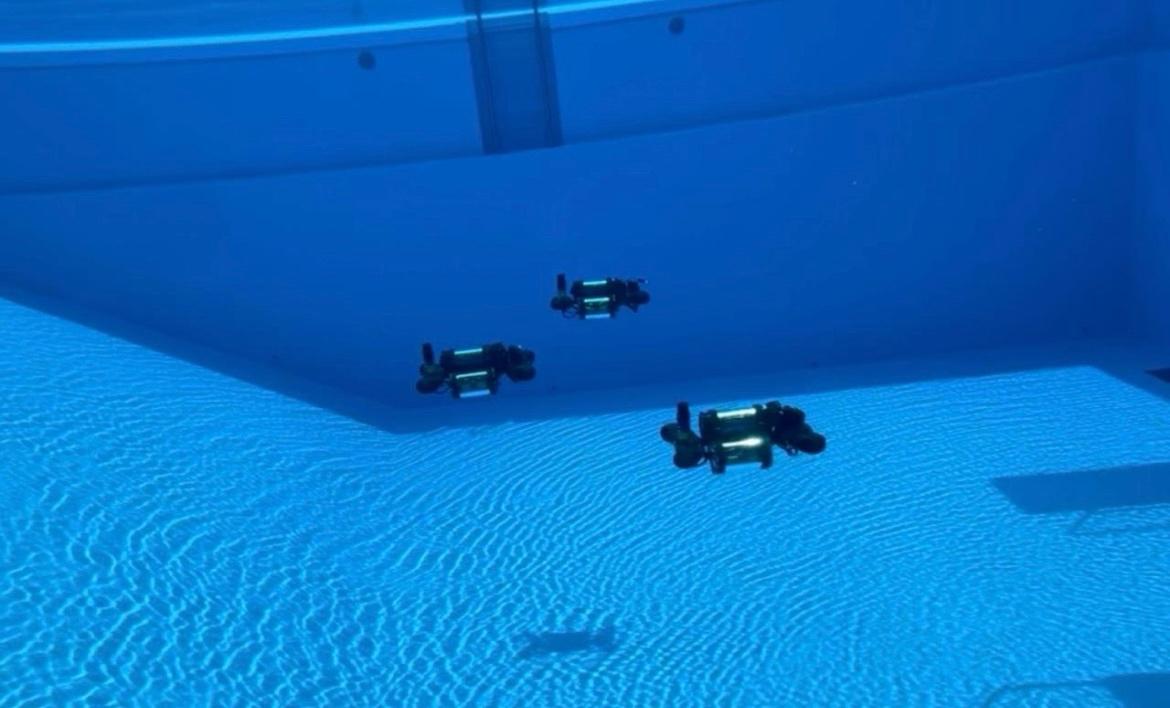
- Accurate localisation and agent-to-agent communication, demonstrated through basic swarm formation control with three agents.
- Reliability and robustness improved through extensive testing in lake environments.
6Media